
The United States turned 250 this year. It's a remarkable achievement, especially when you consider the odds against us from the republic's founding to today.
We've either had otherworldly luck, or a higher power has intervened on our behalf. Winning independence from the most powerful state on the planet up to that point in history; fighting another war against that same state and surviving; the country constantly threatening to fly apart over slavery; a civil war that killed 600,000 of our countrymen; two world wars that needed to be won; and a host of other challenges, any one of which could have spelled our doom, have given the American people a sense of invincibility.
There is nothing written anywhere that says America will live forever. We are an accident of history. The great counterfactual author, Orson Scott Card, made a career out of imagining a very different history for the United States. Plausible? The "What Ifs" of American history are a great parlor game to play, and we all probably have our favorites. Mine is the battle where only a British captain's honorable actions saved George Washington's life.
At the Battle of Brandywine on September 11, 1777, British Captain Patrick Ferguson, an expert marksman, took dead aim at an American officer, who many historians believe was George Washington, who had come into clear view and well within range of Ferguson's rifle. Although Ferguson had him directly in his crosshairs, he ultimately refused to pull the trigger. As Ferguson later wrote in a letter, he felt it was unchivalrous and "disgusting" to shoot an unsuspecting officer in the back while his attention was elsewhere. Ferguson only learned later from American prisoners that the officer he spared had likely been General George Washington himself.
Washington dead in 1777? Imagine the rest of the war and the early republic without him.
American history is replete with examples of the entire American enterprise faltering and disappearing because a bullet missed its target or because a different path was taken, reminding us just how fragile our national beginnings truly were.
Imagine John Wilkes Booth being stopped at the entrance to Ford's Theater, or the attempt on Franklin Roosevelt's life after he was elected president but before he took office succeeding. There's a school of history that downplays the "Great Man" theory of history, which includes individual historical events not changing history's outcomes, and the contention that other unseen forces play a far bigger role in the march of time.
It's a compelling argument, but I'm not sure it applies in all cases. The death of George Washington, whom his best biographer, Thomas Flexner, called "the indispensable man," would have radically changed history.
America is not invincible, nor is it immortal. It's something France, to its horror, is beginning to realize.
Both Great Britain and France have allowed people who hate them and want to destroy them into their countries. They've given them public aid, coddled them, even protected them from arrest. We're fond of saying in America that "the Constitution is not a suicide pact."
No such adage exists in either France or Great Britain.
Look at any of the terrorist atrocities of recent years and you will see the same pattern. Britain – under Labour and Conservative governments – has consistently refused to do the obvious thing: deport and close the borders. Instead it has repeatedly let in the people who have been the most visible, vocal enemies of this country. Take any terrorist group and Britain has welcomed them in instead of repelling them.
The Iranian regime official who wrote a book justifying the fatwa against Salman Rushdie? Living in Harrow. The former military chief of Hamas in the West Bank? Living in Barnet. Bodyguard of the terrorist leader Ismail Haniyeh? Granted asylum in the UK and wandering around planning attacks.
France has a similar problem. Saïd and Chérif Kouachi, the gunmen who attacked the offices of the satirical magazine Charlie Hebdo in Paris, killing 12 people, had been known to Western intelligence services for years. U.S. and European officials later confirmed that in the coordinated attacks across Paris that killed 130 people, multiple assailants — including at least one of the main suicide bombers — had been logged in international counterterrorism tracking databases before the attacks took place.
It's almost beyond belief. The mastermind behind the 2015 Paris attacks, along with several members of his terror cell, were already on European and international watch lists, having traveled back and forth to Syria undetected, despite active arrest warrants.
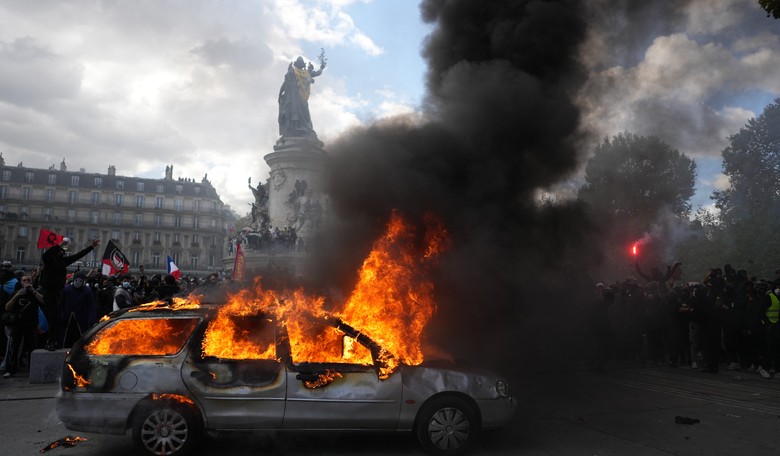
"The French riots have many causes," writes Douglas Murray in The Spectator. "But among those burning France down are people the French allowed to come into their country." They came from countries where most of its inhabitants hated the West, hated our values, hated our religion, and had a burning, evangelical desire to destroy it.
The French, like the left in this country, are more enamored of maintaining their self-image as great humanitarians and heroic defenders of liberal values than they are in recognizing the danger some of the newcomers pose. As fire consumes Paris, Lyon, Marseille, and other French cities this weekend, we should recall the Roman slave who rode in a Roman general's triumph who whispered in his ear, "Memento mori" (which translates to "Remember thou art mortal").
France would do well to take that whispered reminder to heart.