
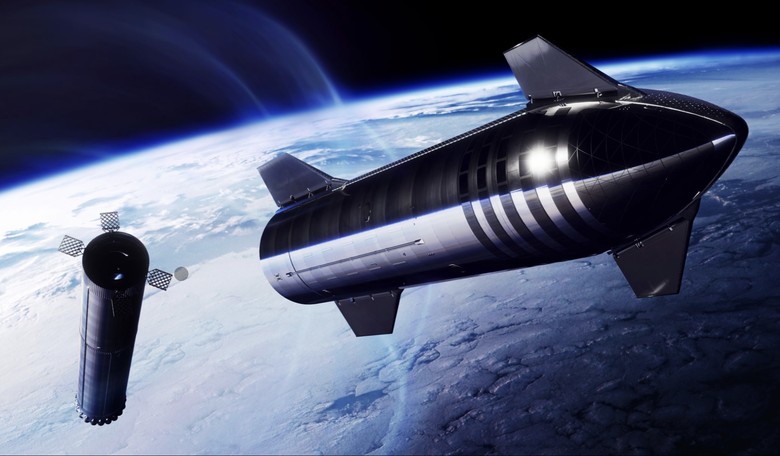
The U.S. Federal Aviation Administration (FAA) is reviewing a proposal from SpaceX, led by Elon Musk, to launch up to 456 Starship rockets per year from spaceports in Texas, Florida, and Louisiana.
Currently, the FAA allows SpaceX to launch 25 flights a year from the company's spaceport in Texas.
"This 456-launch proposal is not just about flying more rockets," notes Nauman Khan of Barchart. "It's about fundamentally changing the economics of space."
Indeed, if Musk can get Starship to fly that often, the cost per pound of sending a satellite into orbit would drop from $3,000 to $100-$200. That's a gigantic leap forward.
With the capability to lift 100 to 150 metric tons (and up to 250 tons in certain configurations) per flight, a high-volume, quick-launch flight schedule would move the global space economy from launching dozens of tons a year to tens of thousands.
What would Starship be putting into orbit? In September, "Starship reached orbit for the first time and deployed 26 Starlink V3 satellites — the first members of a new broadband constellation that could eventually consist of 100,000 spacecraft," reports Space.com.
Assembling that network will require a lot of Starship launches. And even more will be needed to build SpaceX's planned Starmind AI megaconstellation, which Elon Musk has said will harbor a million satellites. Indeed, the world's richest man has said that SpaceX is targeting more than 10,000 Starship liftoffs per year by 2030.
Not all of those flights will originate from Starbase, which hosts two orbital pads. SpaceX is working to get three Starship pads up and running on Florida's Space Coast, and the company aims to break ground on a $100 billion, 12-pad complex in Louisiana next year.
Each operational Starship launch will also feature two landings. Both of the vehicle's elements — the Super Heavy booster and Ship upper stage — are designed to return to the pad after liftoff, where they will be caught by the tower's "chopstick" arms. So SpaceX's proposal for 456 launches from Starbase per year includes a request for approval for 912 landings.
SpaceX plans to scale up quickly to a massive number of launches in two stages: Phase 1 "would include up to 100 annual launches and up to 200 annual landings (100 of Starship and 100 of Super Heavy)," the FAA wrote. "Launches and landings could occur any day or time of the week."
"Phase 2 covers 456 launches and 912 landings, which would occur only Monday through Friday," says Space.com.
The scoffers and naysayers don't understand Musk's plan. Even if Musk achieves only half the launches he says he wants by 2030, it would be an incredible achievement and a game changer for humanity. Orbital space stations would manufacture optics, specialized crystals, and semiconductors in microgravity without the defects caused by Earth's atmosphere and gravity. It would lead to a boom in space tourism. It wouldn't be as cheap as a trip to the Wisconsin Dells from Chicago, but it would put space within reach of upper-middle-class families. It would also enable rapid long-haul terrestrial transport via suborbital hops.
It would put projects like asteroid mining, previously prohibitively expensive, within the realm of the possible. Ultimately, Starship's economic impact relies on successfully bridging the gap between ambitious multi-launch infrastructure proposals and reliable, routine, low-cost execution. If realized, it transforms space transportation from a specialized government/commercial service into a foundation for a multi-trillion-dollar space economy.
The FAA's environmental review will be a fascinating exercise in government's regulatory authority. Serious environmental issues need to be studied and resolved before Musk ramps up the cadence of launches. Since the launch sites in Texas, Louisiana, and Florida are, by necessity, in uninhabited areas, the impact on fragile ecosystems might include risks of driving away local wildlife, altering bird migration patterns, and disturbing marine life. Then there is the potential damage to the upper atmosphere.
If Musk launches thousands of rockets a year, the impact could theoretically be devastating. Frequent launches and the eventual reentry of spent upper stages, decommissioned mega-constellations (like heavy Starlink satellites), and orbital debris shed aluminum, titanium, and other metals into the atmosphere. Recent atmospheric studies note that human aerospace activity is introducing measurable concentrations of metallic particles into stratospheric aerosol layers, raising concerns about long-term impacts on cloud formation and ozone stability.
What's the impact of billions of tons of burned rocket fuel on the atmosphere every year? Before reaching that scale, we need a clearer picture of how launching orders of magnitude more rockets annually would impact Earth’s ecosystems and upper atmosphere.
To my mind, these are minor problems compared to the breathtaking infrastructure build-out and the sheer audacity of Musk's vision. I compare it to John F. Kennedy's audacious promise made on May 25, 1961, to send Americans to the Moon and return them to Earth by the end of the 1960s. Kennedy made that bold promise after Alan Shepard's suborbital flight on May 5. When JFK made that commitment, Americans had spent only 15 minutes and 28 seconds in space.