
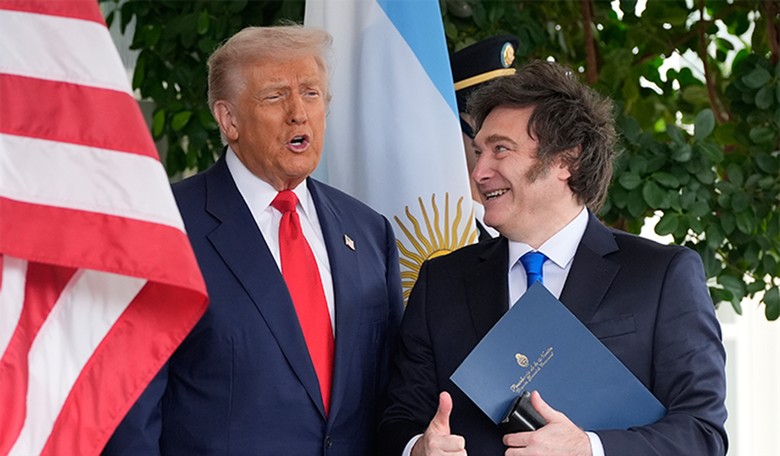
Argentine president Javier Milei did not hold back when speaking at the United Nations on Wednesday. As a matter of fact, he used some language that we don't typically hear in that setting, but he was spot on.
He called the UN "a useless organization that only serves to feed a caste of fatally arrogant parasites disguised as well-intentioned bureaucrats." To its face.
Well done, sir.
Milei said that while the organization's original mission of resolving conflict peacefully and promoting freedom was noble, "today, regrettably, it is time to acknowledge that, in practice, that sacred covenant has been broken." He cited examples like gender agenda, environmental extremism, and unchecked immigration, along with the "genocide" of COVID-19 restrictions.
During the pandemic, bodies under the auspices of this house put themselves before scientific evidence and the sovereignty of nations and promoted forced lockdown policies throughout the world. Where some allege a public health policy error, we see a global experiment in social control disguised as science. And when a state wearing public health blinkers deprives its population of the right to work, to receive an education, and to bid farewell to their dead, this results in millions of avoidable deaths. There is a word for it: genocide.
"Those who were supposed to guarantee collective security and human rights failed in their task. They allowed chaos, violence, and international terrorism to flourish," he continued. "The alleged defenders of human rights have sheltered bloodthirsty dictatorships and regimes that stone women in the streets; they have systematically voted against Israel while remaining silent in the face of Islamic terrorism and the genocide of Christians in Africa."
He also pointed to something more personal: the lack of resolution in the Malvinas Islands sovereignty dispute between Argentina and the United Kingdom:
Fifty years ago, this same assembly adopted Resolution 3149, urging the parties to refrain from introducing unilateral changes while the dispute remained unresolved. Fifty years later, the situation has not changed.
Today, the Sea Lion project is moving toward oil extraction on the Argentine continental shelf — specifically in the North Malvinas Basin — under British licenses that Argentina rejects as illegal and illegitimate.
This leads me to ask: What is the use of a resolution if, for decades, the opposing party can act in direct contradiction to it, leaving the resolution sitting in the archives, intact yet powerless against reality? There is no shortage of words or resolutions; what is missing is consequences. For an institution that fails to make its voice carry weight in actual events loses the most important thing of all: its authority,” the Argentine president accused.
That is why Malvinas is not only an issue between Argentina and the United Kingdom. It also raises a question about this organization’s ability to enforce its own resolutions.
"Faced with the UN’s impotence, we made a decision," he said, stating that Argentina would not wait for the UN or the world and would take matters into its own hands.
Among other things, Milei talked about how Argentina is aligned with the West, the United States, and Israel, and not the UN's woke agenda. He also opposed state control of AI and said the world must embrace it, seemingly backing up Donald Trump's thoughts on the matter.
"Where many see a threat, we see a frontier," he said. "Artificial intelligence, or superintelligence, as President Donald Trump calls it, could multiply our productivity by orders of magnitude that we still do not understand."
He finished with his famous catchphrase "¡Viva la libertad, carajo!" or "Long live freedom, dammit."
While Milei was ripping the UN a new one, his Minister of Foreign Affairs Pablo Quirno joined U.S. Deputy Secretary of State Christopher Landau in signing the Andes-Atlantic Corridor, what the State Department calls a "joint initiative to strengthen and modernize infrastructure linking Argentina’s vital economic sectors to major Atlantic ports and Western markets."
In other words, unlike the UN, they were getting stuff done. The ultimate goal of the initiative is to promote more mineral, oil, and gas exports; create a Western Hemisphere supply-chain hedge, and allow U.S. firms to become the bidders and suppliers.
The State Department's statement specifically mentions the two countries strengthening cooperation on transportation, the energy sector, the minerals sector, and the digital sector.
According to the State Department, "The Corridor will help unlock billions of dollars in investment, expand opportunities to U.S. companies, and strengthen supply chains for critical minerals and energy, including lithium, copper, oil, and gas. It is the first Partnership for Global Infrastructure and Investment Corridor in the Western Hemisphere, deepening U.S.-Argentine economic integration and connecting investors to opportunities across Argentina’s energy, mining, infrastructure, and technology sectors."
It added that Milei's economic reforms have helped create this opportunity, "which will expand economic cooperation and provide financing of up to $7 billion by 2027."
Recommended: Venezuela: Trump and Delcy Pose for a Picture. María Corina Machado Denied Entry.