
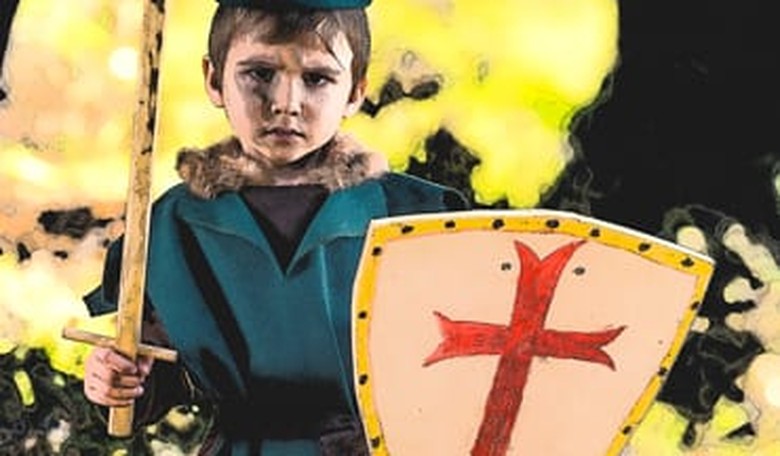
This isn’t going to be an article about how to interest children in roleplaying games (RPGs): I’m not here to do product placement, and I don’t have any direct experience yet in what kind of RPGs my kids will like. No, the purpose of this article is to talk about kids showing up in RPG campaigns, in the sense of why they should be there, if only in the background. But maybe ‘only’ is not the right word to use, there. So many interesting things happen in backgrounds, after all.
First off, there’s a very practical reason why kids should be always showing up in your RPGs: because it tracks with historical norms. To give one example: even today, when the fertility rate is historically low for this country, three-quarters of the population of the United States have had at least one child, as well as just over half of the population between 18 and 40. And note the ‘historically low’ part; in the past, and in many of the places where we draw our inspiration for fantasy literature, childbirth rates were higher (as well as childhood mortality rates). Children were pretty much everywhere*, in other words.
Now, admittedly, this may not be true in a specific campaign; perhaps the fertility rate in one particular fantasy or space opera realm has sunk through the floor, so children are rare. Well, right there can be the inspiration for any number of adventures, themes, or motivations for non-player characters (NPCs). So, it’s obviously OK to not have your campaign reflect historical age-demographic trends… but you might be doing your campaign a disservice if you simply ignore said trends. Ideas are where you find them.
As to how to use kids in your campaign… yes, you’ve already rattled off “menace them to show the player-characters (PCs) just how bad the villain is” and “revisit the joys of Oliver Twist and bad Cockney accents by having the inevitable criminal gang of children show up.” Not that there’s anything wrong with those two plots, at least when they’re used sparingly — but you’d like more useful suggestions, I’m sure. Fortunately, there are some ways to play with both of the above cliches.
- Let’s start with ‘menacing.’ It doesn’t have to happen on-screen. Human beings can be very complex, very contradictory creatures in the aggregate sometimes… but history tells us that one of the most reliable ways to get from “tense, but quiet streets” to “Night of the Mob” in a single day is to have somebody in power publicly harm or kill a child. It doesn’t even have to happen, sometimes: just the rumor is often justification enough for street violence. Slightly more positively: a lost child can galvanize the local community just as thoroughly, but in a constructive (rescue) instead of destructive (retribution) manner. Either scenario would make an excellent environmental hazard or obstacle for a party of PCs.
- Sure, prodigy child thieves can be a thing in games. Prodigy children in general. But here’s an entertaining thing to throw at your players in a fantasy game: they’ve been ordered to go do a mission for the Baron of Whomever. The Baron of Whomever is eight, and is amusingly not under the control of a regent. Watch the party join the rest of the Baron’s men in maneuvering around this problem. Or perhaps the child is twelve, and has already been in several battles, and both he and his men expect the party to take him seriously. That can produce a whole different set of complications.
Of course, there is one basic meta-issue with all of this: if your average party comes across a child that’s in any kind of danger, has any kind of authority, and/or seems relevant to the plot, however tangentially — well, the party is going to track that child’s whereabouts until the adventure is over, and possibly beyond that. That’s because the unconscious assumption there by the players is likely to be that the child is a major plot point in one way or another. It’s OK to distract the players like that, of course; but sometimes you don’t actually want them distracted. Or at least you don’t want them to stay distracted. Just something to keep in mind.
*Mind you, there are valid reasons for not reflecting this in video games – or movies/television, come to think about it. One of the perennial problems in video game RPGs is that one of the absolute best ways to kill performance is to load up the screen with a bunch of randomly walking around ‘extras.’ It’s not much better if the extras are ‘kids’ instead of ‘adults,’ honestly. As for live action performances? …Child actors come with a lot of special conditions, restrictions, and paperwork.