
A few weeks ago, I was approached by a friend and asked if I would like to attend an event where a hog or two is killed; the hog is strung up and butchered into primal cuts; classes are given on sausage making, pork rind frying, souse meat, Brunswick stew, and soap making. To the layman, this would possibly elicit the gag reflex, but to me it was a sign from above that I was about to be steeped in all things pig. Oh, GLORIOUS pig!
I couldn’t say “YES” fast enough and began to count the days until my time at Old South Farm Museum and Ag Center in Woodland, Ga., quickly approached.
What did I take from my day in hog heaven (insert joke here)? Aside from samples of the goodies mentioned above, I took home a better appreciation of where our food comes from. The whole setting was a bit antiquated in that the butchering and meat curing were being done by hand instead of in a stainless steel-covered factory. But please remember that how you and I get our sausage and cold cuts from the grocery store, all neatly packed in plastic-covered, sanitary freshness, is a relatively new phenomenon. For hundreds of years it was (and in some circles) still done on the farm: field-to-table existence at its best.
Related: Let's Eat! 'He Actually Ate It?'
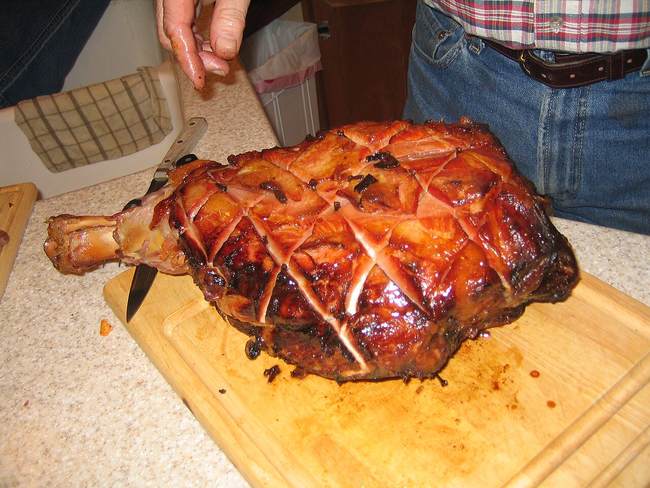
Now here is where I take my newfound knowledge and put it into practice: I am now in the middle of meat curing bliss. I have a fresh picnic ham in the fridge that is a month and a half old. Is it bad? Nope, it’s only getting better. It has gone through a three-step salt/sugar/sodium nitrate curing process on its way to becoming what is known as “country ham.” That salty, chewy, deeply ham-flavored chunk-o-meat that you just can’t get everywhere. It takes time (and since time equals love), and it takes love as well. You just can’t make it happen after a couple hours in the oven. It has to develop its flavor after months of curing, smoking, and finally being hung in a cool, dry place. Mine will be ready sometime in August — yum.
That leads me to bacon. Pushing my interest yet a step further down the road of obsession, I decided to try my hand at bacon. Who doesn’t love bacon? A vegan? They don’t count in the land of meat, so off I went into the low-slung world of pork belly. First of all, do you know how hard it is to find fresh pork belly? It isn’t easy. Sure, you could mail-order it from an organic farm in Timbuktu, but I wanted local. And I found it near Augusta, Ga., at Thomson Packing Company in Thomson, Ga. I got 11.57 lbs from my Saturday morning road trip. I brought it home and cut the pork belly in half for two separate batches of bacon.
Bacon only takes seven days to cure, so a nice, soft applewood smoke was in order when my curing was complete. After about 10 hours of gentle, low-heat smoke, my slab was ready for the frying pan. It turned out a little salty for my first turn, but the flavor was spot on. I sliced the next batch up and soaked it in fresh water for about 10 minutes to leach out a bit of the salt. That was the ticket. Bacon nirvana had been achieved. I can die a happy man.