
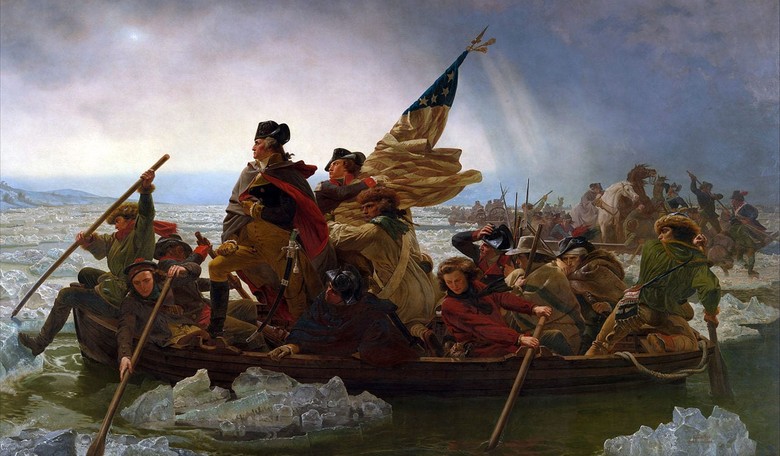
Exactly 250 years ago, Col. John Glover and his Marblehead troops fought a crucial battle with the British in New York. Glover and his outnumbered men lost the field, but won the day nevertheless, for without their action, the British could have caught up with and disastrously stopped the Revolutionary Army’s retreat. The American cause would live another day.
The Marbleheaders (called after their Massachusetts town) had already helped the Army out of a tight spot, rowing the troops across the East River in the dark and fog, according to writer Duane Montague. They would once again prove vital to the American cause on Christmas 1776, when they would accomplish the miracle of transporting the Army and artillery across the Delaware River for the victory at Trenton. That famous moment is captured in the idealized painting above by Emanuel Leutze.
Whenever George Washington needed a miracle, he turned to John Glover. And Glover and his Marbleheaders, a quintessentially American mix of men from multiple racial and economic backgrounds, always came through.
Pelham Town Historian Arthur Scinta sums up the crisis that faced Washington and Glover leading up to the fateful fight on October 18:
After [the Brits] decimating the Americans in the Battle of Long Island, General George Washington and the Continental Army were pushed into a corner in what is now Washington Heights. Hoping to surround them and cut off a retreat north to White Plains, British warships sailed north, eventually landing in the Manor of Pelham. Enter one Colonel John Glover and three other colonels in charge of four regiments, upon whom rested the entire American cause. Had it not been for their courage, determination, and Yankee ingenuity, the British would have marched across Pelham, overtaken Washington and the Continental Army in their retreat to White Plains, and America's Revolution would have been over.
Not every battlefield loss is a tactical loss. Outnumbered as they were, Glover and his men fought bravely and well until the rest of the army could get away.
For Our VIPs: Webster and Wilde: The Importance of Teaching Kids Truth
Scinta notes that the location of the battle, also sometimes called Pell’s Point, is debated, with Prospect Hill as a potential location. Glover himself simply said, “The enemy had the advantage of us, being posted on an eminence which commanded the ground we had to march over.” The fighting likely extended over a relatively large area, with about 750 Americans fighting around 4,000 British and Hessians along the road, mostly from behind stone walls. Glover and Colonels Loammi Baldwin, Joseph Read, and William Shepard commanded the Americans. Trying to make the best of his unfortunate terrain and lower numbers, Glover split up his men behind a double roll of stone walls, according to Scinta.
Glover himself described the battle. “The enemy gave a shout and advanced; Colonel Read’s laying under a cover of a stone wall undiscovered till they came within thirty yards, then rose up and gave them the whole charge; the enemy broke and retreated for the main body to come up,” he wrote. “In this situation, we remained almost an hour and a half, when they appeared about four thousand, with several pieces of artillery; we kept our post under cover of the stone wall before mentioned till they came within fifty yards of us, rose up and gave them the whole charge of the battalion; they halted and returned the fire with showers of musketry and cannon balls.”
When the Brits came upon Shepard’s men, they fired by “grand divisions, by which he kept up a constant fire, and maintained his post till he exchanged seventeen rounds with them, and caused them to retreat several times; once in particular so far that a soldier of Colonel Shepherd’s [sic] leaped over the wall and took a hat and canteen off a [British] Captain that lay dead on the ground they retreated from.”
Scinta explains that Glover's clever strategy made the British and Hessians think there were a lot more Americans than actually were hiding behind the walls. At the right moment, Glover strategically withdrew, saving his men from the likely slaughter that would have occurred if the enemy had ever figured out how few they were. The Hessians in particular had already demonstrated in New York their viciousness toward captured Americans. Six Americans died, and 20 suffered injuries, including Shepard. Scinta says that Shepard allegedly took a drink, noted that water was not coming out of the bullet hole in his neck, and promptly took command of his regiment again. But the British dead were at least 200.
Washington’s Army escaped, and it was somewhat of a Pyrrhic victory for the British. They lost a great many more men fighting a much smaller force of Americans while the main army slipped away. The Revolution was not over yet.